|
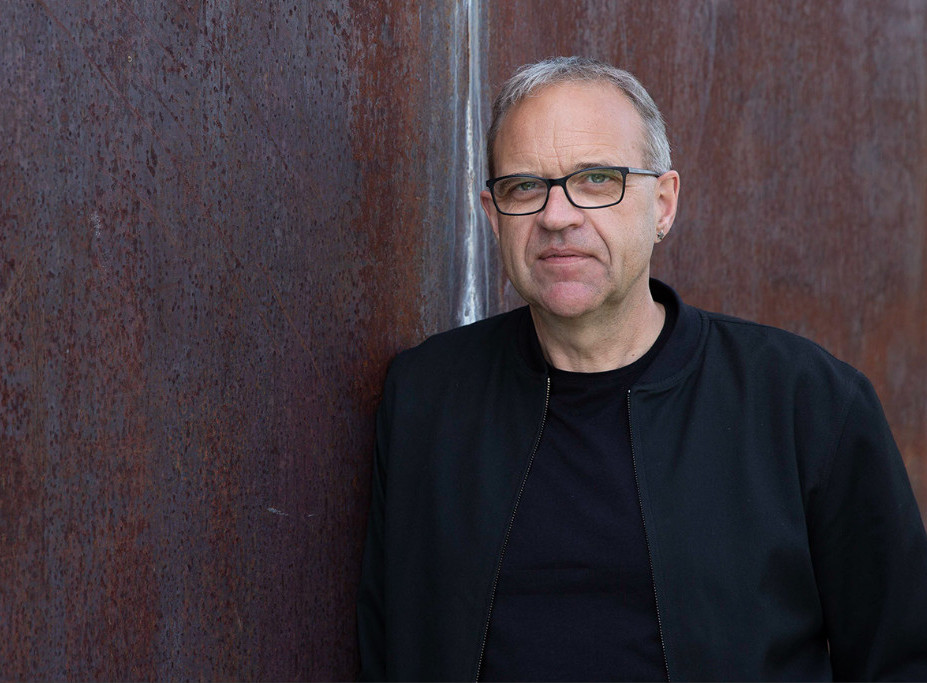
BURKHARD BEINS
born 1964 in Lower Saxony, lives in Berlin since 1995. As a composer/performer working in the fields of experimental music and sound art he is known for his definitive use of
percussion in combination with selected objects. Furthermore he works with electronics, electro-acoustic instruments and devices. Since the late 1980's he is performing at internationally renowned venues and festivals throughout Europe,
America, Australia and Asia as diverse as the LMC Festival (London), Darmstädter Ferienkurse, SKIF (St. Petersburg), Donaueschinger Musiktage, Musique Action (Nancy),
ZKM (Karlsruhe), Kid Ailack Music Hall (Tokyo), Gaudeamus Festival (Amsterdam), Liquid Architecture (Australia), Taktlos (CH), Wien Modern, MoMA (New York), or Maerzmusik (Berlin).
He is a member of groups like Perlonex, Activity Center, Polwechsel, Mensch Mensch Mensch,
Phosphor, The Sealed Knot, and Splitter Orchester and also works with Keith Rowe, Sven-Åke Johansson, Chris Abrahams, Orm Finnendahl,
John Tilbury, Charlemagne Palestine and many others. "Burkhard Beins is best known as one of the most distinctive percussionists in European free music." - The Wire - "Burkhard Beins has proven to be one of those players delivering consistently intriguing releases." - Signal To Noise - " ...simply one of the most imaginative percussionists around, indeed making the tag 'percussionist' seem hopelessly deficient." - All Music Guide - |
It seems to be characteristic for and certainly a major asset of the so called Echtzeitmusik-scene that musicians
of quite diverse musical background, ranging from academic composed music via jazz or free jazz and rock to electronic
music, are able to collectively achieve something beyond which is possibly informed but not necessarily limited by all
those ingredients. And for myself I have not even been a trained instrumentalist of any sorts at all before I started to
engage in experimental music. Instead of working myself away from something I had learned in order to approach
uncharted territory I was always sighting a musical or sonic area I wanted to explore first before trying to find or develop ways to be able to do so.
Heavily influenced by all the different musics I loved - electronic music and musique concréte in their already filtered
versions of Brian Eno and Frank Zappa, the experimental fringes of Punk and New Wave like This Heat, Zoviet*France or Negativland,
as well as the New York Downtown Scene next to AMM and British Improv - I began experimenting with multitrack tape collages
during the 1980's involving sound sources like field recordings, tape loops, percussion instruments, found objects, and a piano stringboard
on a table. Although there was always also a drum kit involved, due to the occasional rock session, I would still regard myself
right from the beginning more as a composer/performer with a certain affection for percussion instruments than as a "drummer".
Nevertheless the early 1990's saw me struggling for an individual approach to percussion (after I had started playing my first
live concerts in the late 1980's together with guitarist Michael Renkel, initially also involving contact mics, tapes and tape
loops next to percussion instruments, but abandoning this for almost the entire following decade). And I slowly began developing
my own language. Participating in one of Günter Christmann's VARIO projects, working on Cornelius Cardew's Treatise with
Keith Rowe and on graphic scores/conducted improvisation with Fred Frith definitely were some key challenges at the time.
Moving to London for a short while in 1995 brought me closer to the British improvised music scene. But while my early
groups like FRAKTALES or NUNC (2:13 Music CD, 1996) could more or less still
be regarded as traditional Improv, and the trio YARBLES (Hat Hut CD, 1997) was
even flirting with Free Jazz, a new aesthetic focus was slowly emerging during the second half of the decade, after I had moved to Berlin in the end of 1995.
The musical off-scene in Berlin, mostly active in the former eastern parts of the city, seemed to be pretty much divided into different camps
in the mid-nineties. The Anorak hosted mostly improvised music with a recognizable 1980's-downtown-NY-influence and created a
scene which was also involving many musicians who became key figures of the so-called Echtzeitmusik. And there was still a quite active
(Ex-GDR) Free Jazz scene running different venues at the time. Berlin was also a hotbed for all sorts of electronic music in the nineties,
but it was only shortly after that the more abstract experimentalists and the more clubby electronica people began collaborating and
mutually influencing each other. So in the beginning it was rather the cheaper cost-of-living holding me in Berlin than a particularly suitable
or welcoming music scene.
It was mostly for this reason that my meanwhile long-term collaborator Michael Renkel, who also moved to Berlin in 1996 and with whom
I had already co-organised the Hamburger Salon (Hamburg 1994/95), and I took the initiative to organise our own series of concerts and
several festivals under the moniker 2:13 Club, a Berlin version of John Bisset's 2:13 Club in London. From 1997 to 1999 our venue Vollrad's Tonsaal
in Berlin-Mitte became an important meeting point for musicians like Axel Dörner, Andrea Neumann, Annette Krebs, or Robin Hayward
(who had just moved from London to Berlin) with Londoners like Phil Durrant, Rhodri Davies, John Butcher, or Mark Wastell, and also repeatedly
with invited guests from the world of contemporary composed music, members of the Ensemble Mosaik in particular.
Like several other projects within this circuit I was investigating the musical potential of long silences and very reduced sound material
in DAS KREISEN (with Krebs and Hayward) for a short but intense period around 1998,
while my duo ACTIVITY CENTER with Renkel also reached a certain point of refined sparseness
around that time, although maybe in a less conceptually rigorous way (2:13 Music DoCD: Möwen & Moos, 1999).
In the SOWARI QUARTET with Durrant, Davies, Renkel and me, some new musical tendencies from London and Berlin found an ideal place to coalesce for a while.
- But it was also in 1998 when Ignaz Schick formed PERLONEX, with electric guitarist Jörg Maria Zeger and me,
a post-industrial noise trio exploring quite different musical territories
(first two CDs on Zarek: Perlon, 2000,
and Peripherique, 2001).
Amongst other things one subject became an issue of constantly growing importance over the last 15 years. Next to acoustic groups like
THE SEALED KNOT (with Rhodri Davies and Mark Wastell) and
ACTIVITY CENTER (in it's acoustic guitar/percussion version) I'm finding myself in an increasing number of
ensembles and projects incorporating acoustic as well as electronic instruments. Besides my work with
PERLONEX also in the Berlin septet PHOSPHOR,
the BERLIN SOUND CONNECTIVE,
BBB,
SLW, or
TRIO SOWARI, in electro-acoustic duo collaborations with
Keith Rowe and
Andrea Neumann, and in interactive computer program pieces with
Orm Finnendahl and
POLWECHSEL.
Working in those electro-acoustic or electronic music contexts predominantly without using electronics myself
(apart from several small electronic devices) forces me to keep on searching for acoustic material of electronic sound
qualities and to further my development of new playing techniques far beyond traditional drumming.
But nevertheless, around the turn of the millennium I got into using audio software for post-producing my own recordings,
now that personal computers and audio software became affordable. From there it has been only a small step to editing and digital multi-tracking.
And it felt somewhat like the closing of a circle to me now.
My solo contribution to
BERLIN DRUMS (Absinth CD, 2004)
and the production of my first Solo-CD
DISCO PROVA (Absinth CD, 2007) are also incorporating field recordings
and samples from old vinyl records next to percussion and objects. And with the new amplified ACTIVITY CENTER
table set up I have finally decided to give this awkward combination of haptic material plus the moving of (non-virtual) knobs and faders a second chance.
Meanwhile I have also developed an extended solo version of this electro-acoustic set up during my sound art residency at
Künstlerhäuser Worpswede in 2009 which culminates in a new Solo-CD
STRUCTURAL DRIFT
involving an e-bowed and propelled zither, looper and analogue synth next to several objects and field recordings.
- Burkhard Beins, Worpswede, July 2009 -